
Caregiving doesn’t always mean kindness; sometimes it hides control and fear. In this blog, I will look at Annie Wilkes’s grip on Paul Sheldon, where obsession and power presents itself under the guise of care. You’ll see how Stephen King’s story exposes the dark side of dependency and the psychological implications of care gone wrong. Keep reading to explore how this Annie Wilkes character study sheds light on manipulation and trauma in unexpected ways.
If you’d like to go deeper than this blog allows the you can join the Reddit discussion on Annie’s complex character.

Annie Caregiver and Captor
Annie Wilkes, a former nurse turned recluse, finds herself in a peculiar position. Her favorite author, Paul Sheldon, has landed in her care after a car accident. Her initial devotion seems genuine; she nurses his wounds and provides shelter. You might first see her as Paul’s savior. However, this care is a facade, masking an unsettling fixation on Paul’s writing. Annie’s love for Paul’s character, Misery Chastain, drives her to desperate lengths, revealing how a fan’s devotion can spiral into madness. Annie’s obsession manifests in subtle ways. She listens intently to Paul’s every word, hanging on his promises. Her acts of kindness, like providing him with paper to write, are not just generosity. They are part of a grander scheme to keep him tied to her world.
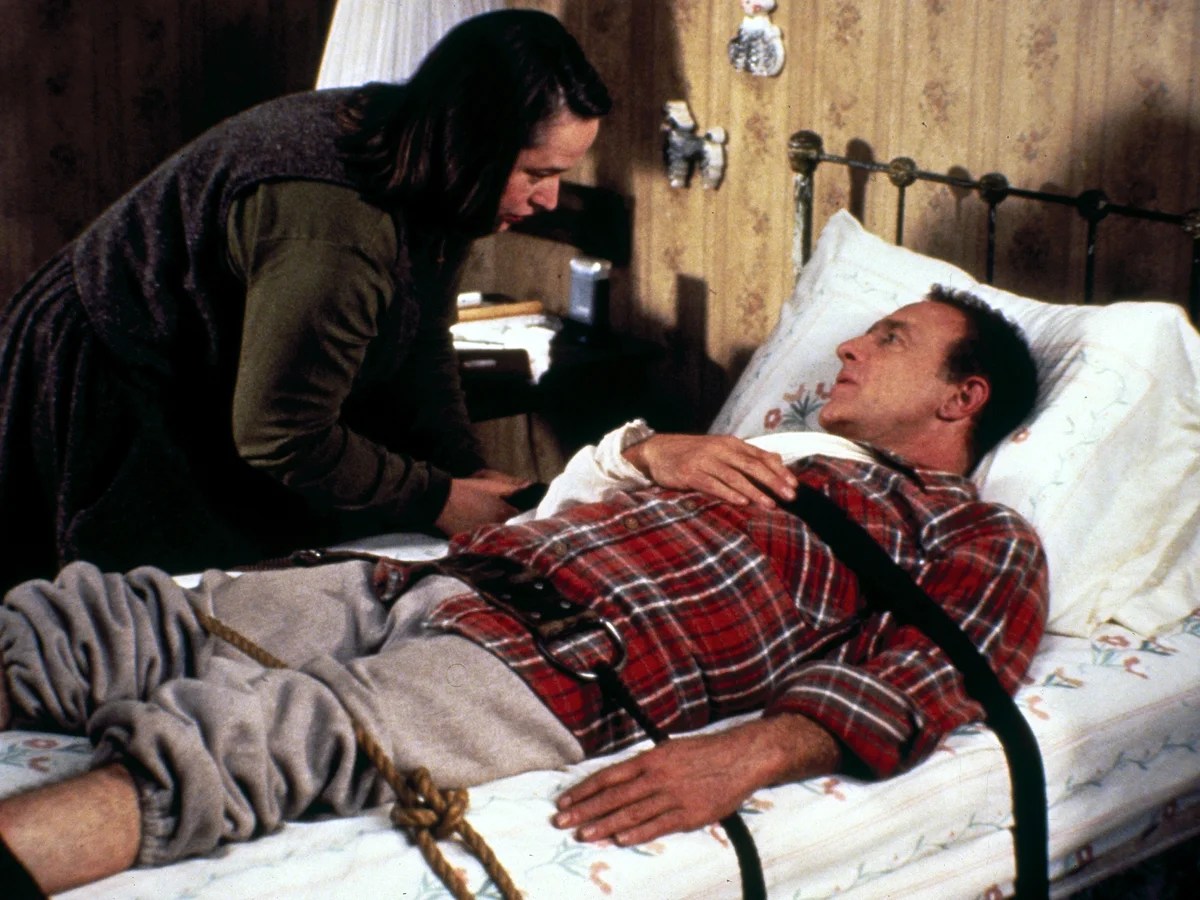
As Paul’s recovery progresses, Annie’s true colors emerge. What begins as care quickly turns to captivity. Paul is not merely a patient; he is a prisoner in Annie’s isolated home. She’s no longer just a caregiver; she becomes his captor. Her cheerful demeanor fades, leaving behind a woman driven by control and power. Annie’s transformation is a chilling reminder of how dependency can easily shift into domination. The twisted dynamic between them raises unsettling questions about the nature of care and control. Her actions are not those of a typical caregiver. She withholds medication, uses manipulation, and even violence to ensure Paul complies with her wishes. The veneer of care is shattered, revealing a person who uses caregiving as a weapon.
Control and Psychological Implications of Care
Annie’s control over Paul hinges on his dependency. Trapped in her home, he relies on her for survival. This dependency is Annie’s greatest weapon. She dictates when he eats, when he writes, and even when he sleeps. Her control over the most basic aspects of his life reinforces her power. For Paul, every moment is a battle for autonomy. This dynamic highlights how dependency can be manipulated into a means of domination, making the line between caregiver and captor blur beyond recognition. Paul’s attempts to assert himself are met with hostility. Annie uses threats and intimidation to keep him in check. Her manipulation is a constant reminder that he is at her mercy, a reality that becomes more oppressive as time goes on.
The psychological implications of Annie’s care are profound. For Paul, the line between safety and danger is constantly shifting. His mental state deteriorates as he struggles with the trauma of his captivity. Annie’s unpredictable nature keeps him on edge, forcing him to navigate a minefield of her moods and demands. This constant stress takes a toll, illustrating the profound impact of psychological manipulation. Annie’s care is a double-edged sword, offering sustenance while stripping away freedom and peace of mind. Paul’s plight is a stark example of how psychological control can be just as damaging as physical restraints. His spirit is battered as he tries to survive in a world where care is synonymous with control.

Annie’s Methods and the Impact on Paul
Annie employs a range of methods to maintain her grip on Paul. Her manipulation is both subtle and overt. She uses guilt and emotional blackmail to keep Paul compliant. Phrases like “I saved you” are used to remind him of his debt to her. This emotional leverage is a powerful tool in her arsenal. Most people think caregivers are inherently kind, but Annie’s actions challenge this assumption. Her methods reveal how manipulation can be woven into the fabric of caregiving, creating a tapestry of control and fear. Her unpredictable outbursts serve as another form of control. By keeping Paul in a state of uncertainty, she ensures his obedience. The fear of triggering her wrath becomes a constant, oppressive presence.
For Paul, the impact of Annie’s methods is devastating. His physical injuries are compounded by psychological scars. The longer he remains in Annie’s clutches, the more his sense of self erodes. His identity as a writer is twisted into a survival mechanism, as he must write to appease her. This enforced creativity becomes a burden, stripping away the joy of his craft. The trauma of his experience lingers long after the physical wounds heal, illustrating how manipulation and fear can leave lasting damage. Paul’s story is a cautionary tale about the dark potential of caregiving relationships. It exposes the vulnerabilities that exist when dependency and control intersect, revealing the hidden dangers beneath the surface of care.


I’d love to hear what you think, please comment below.